
E-commerce · 7 min read
The lean Shopify and WhatsApp stack for a small store: what each tool does and what it costs a month
A small Shopify store can run order updates, campaigns and a shared WhatsApp inbox on four cost lines: Shopify, one WhatsApp platform, Meta's per-message fees and, only where needed, a small bridging step. Here is what each one does, with a worked UAE month.
Updated 6 November 2026 · GoDesign build team
The short version
- Shopify stays the record for orders, customers and consent, and sends the email through Shopify Messaging, free up to Shopify's monthly allowance.
- A WhatsApp platform such as BotSpace starts at about $15 (AED 55) a month on its Pro plan, with Meta's message fees passed through without markup.
- In our illustrative UAE month, one marketing broadcast to 1,000 opted-in people costs about AED 183, more than all the order and delivery updates combined.
- A full CRM can wait until 3 to 6 months of real data show what it would be for.
For a small store, the running cost of Shopify WhatsApp automation comes down to two recurring numbers: a WhatsApp platform subscription and Meta's per-message fees. Shopify already holds the orders and can send the email, so the lean stack adds one WhatsApp platform, pays Meta per message, and uses Shopify Flow or n8n only where one tool cannot pass a detail to the other. In the UAE, the busy month we work through below comes to roughly AED 375, a little over $100, and almost half of that is one marketing broadcast.
We worked these numbers out for a UAE store that asked us for a CRM. The full account of that discovery is on godesign.ae; this guide covers only the stack and the bill.
What does each tool in the stack do, and who pays for it?
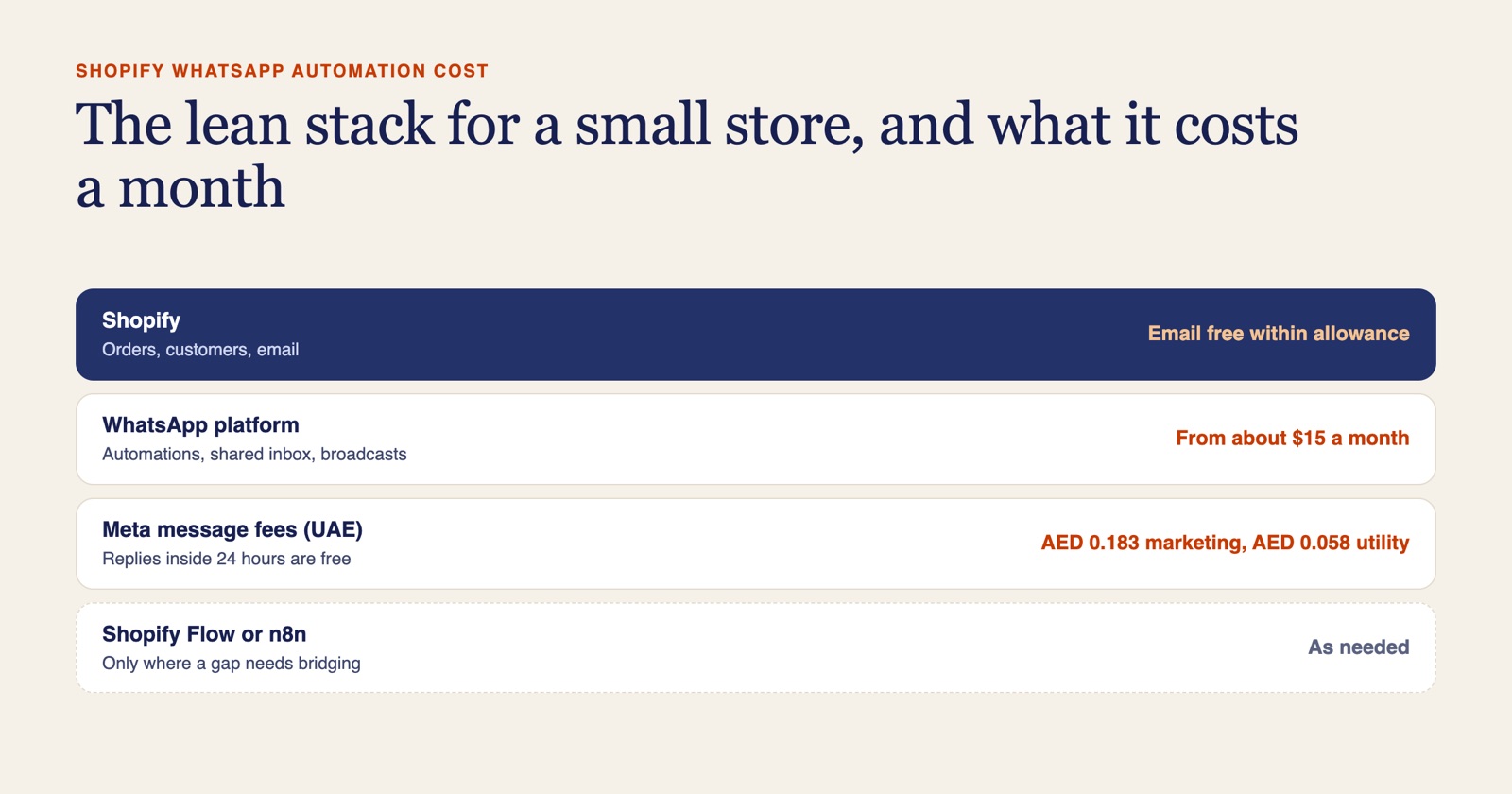
There are four lines and each has one job. The table assumes you already pay for a Shopify plan, so it shows only what the WhatsApp and automation side adds.
| Tool | Its job | Monthly cost | Billed to |
|---|---|---|---|
| Shopify with Shopify Messaging | Holds orders, customers, subscriptions and consent; sends every email | Part of your plan; email free up to Shopify's monthly allowance | The store |
| WhatsApp platform (we use BotSpace) | Shared team inbox, menu, order and delivery messages, broadcasts to opted-in segments | Pro plan from about $15 (AED 55) | The store |
| Meta message fees | Charged per template message delivered, by category | Marketing about AED 0.183, utility AED 0.058; replies in the 24-hour window free | The store, passed through by the platform |
| Shopify Flow or n8n | Carries a detail across when one tool cannot write it to the other | Flow comes with Shopify; n8n only if a step needs it | The store |
Why should Shopify be the source of truth and the email sender?
Because it already is. Every order, customer and subscription lands in Shopify first, and the segments a small store needs (repeat buyers, one-time buyers, high basket value, interest in an occasion) can be built from data already there. A second database at this stage only gives you two places to keep correct.
Shopify Messaging handles the email: welcome, abandoned checkout, order confirmation and seasonal campaigns. It is free up to the monthly allowance on your plan, which a modest list sending a campaign or two a month usually stays inside. Past it, Shopify charges per thousand emails, so check the allowance in your admin before a heavy month.
What does a WhatsApp platform add, and what does it cost?
WhatsApp is where most UAE customers actually answer, so this line earns its fee. Connected to Shopify, the platform gives the team one shared inbox instead of chats spread across staff phones, sends order and delivery messages when Shopify events fire, and broadcasts only to people who opted in.
We use BotSpace. Its Pro plan starts at about $15 a month (around AED 55), and Meta's message fees pass through at cost. That matters more than the plan price: some providers add a percentage or a flat fee per message on top of Meta's rate, which hardly shows until you broadcast. Wati and Respond.io do a similar job; whichever you compare, ask whether the Meta fee is passed through untouched.
What do Meta's per-message fees come to in a typical month?
Meta charges per template message delivered, by category and recipient country. For UAE numbers, a marketing template costs about AED 0.183 and a utility template, such as an order update, about AED 0.058. Replies inside the 24-hour service window, which opens each time a customer messages you, are free.
| Message | Category | Count | Rate (AED) | Cost (AED) |
|---|---|---|---|---|
| Order confirmation with delivery date and slot | Utility | 300 | 0.058 | 17.40 |
| Out for delivery, then delivered | Utility | 600 | 0.058 | 34.80 |
| Google review request | Budgeted as marketing | 300 | 0.183 | 54.90 |
| Checkout reminder | Marketing | 150 | 0.183 | 27.45 |
| One broadcast to 1,000 opted-in people | Marketing | 1,000 | 0.183 | 183.00 |
| Replies inside the 24-hour window | Service | Any | Free | 0 |
| Meta total | 317.55 |
Add the platform at about AED 55 and the month comes to roughly AED 375. Email through Shopify Messaging adds nothing while you stay inside the allowance.
The broadcast is the line to watch. One send to 1,000 people costs more than every confirmation and delivery update combined, so the bill follows how often and how widely you broadcast far more than order volume. Segmenting before a send is the biggest saving available.
Treat the total as a ceiling. If a customer messaged you within the last 24 hours, updates sent inside that window cost nothing. We budget review requests at the marketing rate because Meta does not always accept them as utility; if yours are approved as utility, that line drops by about two thirds.
When do you need Shopify Flow or n8n?
Only when one tool cannot pass a detail to the other. A WhatsApp platform connected to Shopify reads orders and customers well, but it cannot always write back: saving the answers from an enquiry chat to the customer record, say, or recording that an order was delivered so the review request has something to trigger on.
When that gap appears, add one small step for it and nothing more. Shopify Flow comes first because it runs inside Shopify at no extra cost; n8n is for steps Flow cannot reach, such as calling the WhatsApp platform's own API. We confirm which gaps are real in the first week of a setup by testing each flow end to end, instead of building a bridging layer just in case.
What can a small store leave out for now?
A full CRM is the obvious one. Marketing CRMs such as Klaviyo are strong on automation and reporting, but they are priced by active profiles, and the free tier stops at 250, which a growing list passes quickly. Picking one now also means a bigger setup and, if the choice proves wrong, a second setup plus a migration.
The better time to decide is after 3 to 6 months on the lean stack. By then you know what customers ask most, which segments buy and which steps the team still does by hand. A CRM chosen then fits the processes you actually run. And because Shopify has been holding clean customer data with consent per channel, moving into a CRM later is a straightforward import.
- Custom code on top of Shopify, which a small team then has to maintain.
- AI replies to common questions, until chat volume outgrows the team.
- A second WhatsApp chat widget. One platform, one widget, one number.
Why pay each vendor directly?
So the accounts belong to the business. We set the stack up, but the Shopify plan, the WhatsApp platform and the Meta business account are all billed to the store, with no markup from us and no retainer. If the store changes agency or brings the work in-house, the number, templates and contacts stay where they are.
It also keeps the bill readable: with Meta's charges on their own line, you can see what the last broadcast cost before sending the next.
Start Meta business verification on the first day of any setup, in the business's own name. It is the step most likely to hold up the first WhatsApp campaign, and if template approval runs late, that campaign can go out by email first.
If you would like us to look at your store and tell you which of these lines you actually need, send us the URL and your busiest dates.
Questions people ask
How much does Shopify WhatsApp automation cost a month?
For a UAE store, the WhatsApp platform starts at about $15 (AED 55) a month on BotSpace Pro, plus Meta's fees of about AED 0.058 per utility message and AED 0.183 per marketing message. Our illustrative month with 300 orders and one broadcast to 1,000 people came to roughly AED 375. Your own volumes will move that figure.
Is Shopify Messaging free?
Up to the monthly email allowance that comes with your Shopify plan, yes. Beyond it, Shopify charges per thousand emails. Check the current allowance in your admin before planning a heavy campaign month.
Do I need Shopify Flow or n8n as well?
Only if the WhatsApp platform cannot write a detail back to Shopify, such as enquiry answers or a delivered status. Use Shopify Flow first, since it runs inside Shopify, and n8n only for steps Flow cannot reach.
When should a Shopify store move to a CRM?
When 3 to 6 months of data show a job the lean stack cannot do. Keep customer data and consent clean in Shopify in the meantime, so the move is a straightforward import.
Who owns the WhatsApp number and the contacts?
The business, as long as the Meta account, the WhatsApp platform and the Shopify plan are opened and billed in its name. That is why we have each vendor bill the store directly.
Built by GoDesign FZE, who build WhatsApp and CRM automation for UAE businesses.
Get in touch
Want someone to just do this part?
The tool is free and stays free. If you would rather hand the work over, tell us what you are dealing with and you get a straight answer on scope, cost and timeline.
- You own everythingRepository, hosting and domain credentials sit in your name from day one, not handed over at the end.
- A written timelineMilestone dates are agreed in writing before work starts, so you always know what ships next.
- One business dayEvery enquiry gets a reply from the person who would scope the work, not a sales sequence.
Media City, Dubai, UAE · DHA Phase 2, Islamabad, Pakistan
Would rather type than fill in a form?
Message on WhatsApp